Ipinapakita ang mga post na may etiketa na Feature. Ipakita ang lahat ng mga post

Lunes, Enero 20, 2014

A new level of risk from smoking residue: Third Hand Smoke

It is common knowledge that the smoke that comes from cigarettes and other tobacco products takes on two forms. The first of which is the smoke that goes inside the smoker’s body, inhaled directly. The second form is the smoke that the smoker exhales. However, a new form of cigarette smoke has been discovered and it is found to produce a new kind of health hazard. Coined “Third Hand Smoke”, this finding contributes to the known risks associated with cigarette smoking.

            The smoke directly inhaled by the smoker from the cigarette is known as ‘first hand smoke’ while the smoke exhaled afterwards is called ‘second hand smoke’. Second hand smoke can be inhaled by other people that are within the vicinity of the smoker. Numerous studies have been committed to studying the health risks of smoking on a first hand basis. The perils of second hand smoke has also received considerable attention for it affects a wider range of people. [1] However, it has been discovered by researchers and doctors from the Dana – Farber/Harvard Cancer Center in Boston, that second hand smoke generates another kind of hazard that pose threats to health, in the form of nicotine residue settling on furniture and other surfaces. [2][3][4] Doctors from the Mass General Hospital for Children, also located in Boston, called these residues Third hand smoke. [3]

            Third hand smoke is defined as the leftover nicotine from tobacco products that has accumulated on surfaces, clothes, body parts, etc. long after the second hand smoke has cleared.[1][3][4] From a more technical and inclusive standpoint, researchers from ASH Scotland developed a three ‘r’ definition of third hand smoke. According to a fact sheet released by the organization, Third hand smoke:

“Describes the residual tobacco smoke pollutants which remain on the surfaces and in dust after tobacco has been smoked, are re-emitted back into the gas phase, or react with oxidants and other compounds in the environment to yield secondary pollutants”. – ASH Scotland [2]

The residue, in itself, is already dangerous because it consists of heavy metal, and radioactive materials. It is said to contain, among others, hydrogen cyanide used in weapons, butane or lighter fluid, lead, arsenic, carbon monoxide, and the highly radioactive Polonium 210, that was formerly used as weapon in Russia. [3][4] However, the more hazardous effect of third hand smoke emanates from the reactive nature of the residues, which can form carcinogens if combined with the right chemicals, one of which is nitrous acid which comes from gas appliances such as stoves, and ovens. [1][2] Once nicotine residues, and nitrous acid combine, ‘carcinogenic tobacco-specific nitrosamines’ (TSNAs) are formed, which is one of the most potent carcinogenic elements known. [1][2] Given that nicotine rapidly adheres to surfaces quickly and is difficult to remove, frequent smoking indoors can quicken the pace of carcinogenic TSNA production. [2]

Third-hand smoke was found to be particularly threatening for infants and toddlers. Infants and toddlers, especially crawlers, have comparably higher contact to surfaces than adults. Children of this age group are also known to frequently insert objects in their mouth. [2][4] In addition, infants have also been found to inhale 40% more household dust than adults. [2] TSNAs can be acquired through inhalation, ingestion, or even just plain contact with skin (dermal exposure). [1][2][3] From this, it can be said that surfaces, objects, even small particles such as dust, that have been exposed to TSNAs or nicotine residues would have already acquired the carcinogenic or radioactive properties and will be extremely dangerous to come into contact with children. 

Not only are these residues invisible, [3] but they are also accumulative and can persist on for months. [1] Simple washing cannot effectively remove these nicotine residues. Soap that is alkaline will not be able to remove these residues, and particles that have stuck on surfaces with textures similar to carpets are practically irremovable. Increasing ventilation as well has been proven to be incapable of removing third hand smoke though it may aid in clearing away second hand smoke.[2]

But what sets apart the hazards of Third hand smoke from that of first hand smoke and second hand smoke? Aside from it being carcinogenic (especially in TSNA form), radioactive, and poisonous, [1][2][3][4] exposure to the lead content, even on small doses,  was also shown to contribute to lower IQs, especially if the exposure starts from a very young age. According to an article on third hand smoke published on the ‘Scientific American’, “the developing brain is uniquely susceptible to extremely low levels of toxins”. [4] In addition, third hand smoke has also been found to be ‘mutagenic’, or is capable of altering genetic material. Researchers from the Lawrence Berkeley National Laboratory in the US discovered that third hand smoke is capable of changing the structure of DNA, but in a damaging way. In addition, the damage that third hand smoke does on the DNA was also found to get worse over time. Aside from the mutagenic nature of third hand smoke, it was also found to be ‘genotoxic’ which, according to the article, is a “known player in the development of cancer and other disease as a result of smoke”. [5]

            At present, there has not yet been any recorded case of disease that was directly caused by third hand smoke. [4] In addition, there has been little real-life evidence to support its capability to directly cause disease although a definite system of TSNA production from third hand smoke has been traced. [2] Despite these, the discovery of third hand smoke, the longevity of its effects, and the risks associated with it still has major implications towards advocating to ‘kick the smoking habit’.

References:
1.      1. LiveScience (2012, Feb 9). ‘Today news: Third hand smoke a danger to babies, toddlers. Retrieved from http://www.today.com/id/35318118/ns/today-today_health/t/third-hand-smoke-danger-babies-toddlers/
2.      2. ASH Scotland. Action on Smoking and Health Scotland, (2011). ASH Scotland: Third-hand smoke. Retrieved from ASH Scotland website: http://www.ashscotland.org.uk/media/3942/Thirdhandsmoke.pdf
3.      3. Rabin, RC (2009, Jan 3). ‘The New York Times: A new cigarette hazard: third-hand smoke’. Retrieved from http://wkeithward.com/Articles/A%20New%20Cigarette%20Hazard%20-%20Third-Hand%20Smoke.pdf
4.      4. Ballantyne, C (2009, Jan 6). ‘Scientific American: What is third-hand smoke? Is it hazardous?’. Retrieved from http://www.scientificamerican.com/article.cfm?id=what-is-third-hand-smoke
5.      5. No author (2013, June 24). ‘Huffington Post: Thirdhand smoke spurs DNA damage, study finds’. Retrieved from http://www.huffingtonpost.com/2013/06/24/thirdhand-smoke-dna-damage-cells_n_3474797.html


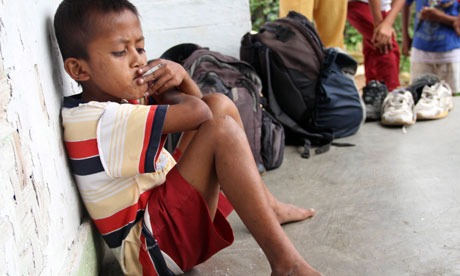
Aldi Rizal: The epitome of underage smoking in Indonesia.

I first heard about the case of Aldi Rizal way back in 2010 when the video of him entitled “Indonesian Baby on 40 cigarettes a day” became viral on YouTube. True to its title, the video did indeed show an overweight toddler in diapers, around 2-3 years of age, puffing cigarettes one after the other. An anachronism at its best, Aldi displayed proficiency in lighting up a cigarette using another one that is already lit, and exhaling cigarette smoke through his mouth and nose.

            According to a feature article written about him on Today, young Aldi started smoking when he was just 11 months old. [1]However, there is no information with regards to who introduced him to cigarettes. Within five months since his first drag, it was said that “he was up to four packs per day”. Because of this, Aldi is described as a ‘local celebrity’ in their fishing community in Sumatra. [1]A celebrity that is famous for all the wrong reasons.

            Aldi’s parents were presented to be completely incapable of controlling their child’s addiction. His father Mohammed, has been quoted saying that his son “looks pretty healthy” and that “there is no problem”. Aldi’s mother Diana mentioned that if her son is denied another cigarette, he “gets angry and screams and batters his head against the wall” and the only way to appease Aldi is by giving him another cigarette. Aldi will only smoke one brand, and this brand costs his parents 3.75 pounds (6 USD/273 php) per day. [2]

At present, Aldi apparently was finally able to kick his smoking habit. [1][2] Since the video of him smoking became popular, the National Commission for Child protection in Indonesia stepped in and provided him with 5 weeks’ worth of play therapy and treatment. However, he apparently has found a new addiction, junk food, and has gained 13 pounds since then. [1]

            Smoking has always been regarded as an adult activity, done with full knowledge and consent. For this reason, it can be said that the case of Aldi Rizal is definitely a perversion of smoking, and childhood most especially.  However, through further research I discovered that underage smoking is a common albeit unfortunate occurrence in Indonesia. [3]The ‘underage’ nature of it takes on an extreme form as children from the same age group as Aldi were seen as also taking a regular drag. [1][2]According to a statistic from the Central Statistics Agency of Indonesia, 25% Indonesian children, 3 to 15 years of age, were found to have already tried cigarettes. 3.2% of these children were regular smokers.[2]The National Commission for Child Protection as well, has been said to receive information from 20 families with children aging from 11 months to 2 years old, has already started to form a smoking habit. [3]

            The influence of culture is perhaps the most dominant contributor in the proliferation of child smoking in Indonesia. Currently the third largest tobacco-consuming country, [2] smoking in itself is seen as an integral part of “coming-of-age” ceremonies. Clove cigarettes (locally known as kretek) are said to be introduced to boys as early as the age of 10, to mark the beginning of a new stage in life. [3] From this, it can be said that the influence of family, the most powerful perhaps are the parents, also play a crucial role. Children who grow up observing their parents smoke regularly, are likely to take up smoking as well in adulthood, if not during childhood, or pre-adolescence. (Determinants of smoking behavior)Peer pressure was also found to be another social factor that contributes to the increase in child smoking. [2]

            Poor regulation of tobacco products has also been noted to contribute greatly to the increase in the prevalence of child smoking. [1] It was only in 2009 when a health law oriented towards the hazards of smoking was passed by legislators in the country,[2]but prior to that there has been no tangible regulatory measures at play that addresses the accessibility of tobacco products to the youth. . [1][4] Aside from this, the amount of promotional activity that the tobacco industry is able to undertake was also unregulated. Tobacco companies were able to advertise their cigarettes on television, radio, malls, conventions, and were even seen to provide scholarships. All of these done in ways that appeal greatly to kids. [1][4] The new health act however is being pushed to regulate the amount of air time that Cigarette Companies receive, as well as the sponsorships and scholarships that they are allowed to provide, it also requires warning labels to be printed on cigarette packets. [1][2][3]

            Despite the strong cultural entrenchment, protests and criticisms against smoking has started to come up. Some of which, are not entirely based on concerns over health and associated risks. The prevalence of smoking among the youth has also been found to affect the economy of Indonesia in the long term. [3]
            The tobacco industry contributes a sizable amount of income to the Indonesian economy. In a study conducted by the International Union against Tuberculosis and Lung Disease regarding tobacco taxation, it has been found that if the current tax of 46% [6]is doubled, an additional income of 3.2 to 6.5 billion US dollars can be incurred. The employment in the country can also be increased by approximately 250,000 jobs. [5] Though the effects of the tax increase on the levels of consumption was unstated, fundamental laws of economics state that an increase in price would mean a decrease in consumption. However, this decrease is still not enough to circumvent the long term detrimental effects of smoking on the economy. The prevalence and increase of smoking among the youth has been found to have extensive effects on manpower, threatening Indonesia’s labor potential. [3]A statement by Mr. Abdillah Ahsan, a professor from the University of Indonesia summarizes the effects of the phenomenon:

“Today’s junior high school students will enter working age by 2020, because of smoking in this age group, many will fall ill and be unable to work. The current youth smoking trend is alarming.” – Abdillah Ahsan [3]

            Labor, if compromised, will greatly reduce the productive capacity of an economy; especially being one of the components of the three-legged stool that is the factors of production. Much like a three-legged stool, if one of the legs of production become nonfunctional, the stool collapses. The human factor of production is oftentimes overlooked. Oftentimes, worker’s overall health, work conditions, and skills development are deemed marginal in importance, as compared to the quantity of plants and equipment, maximization of profits, and the like.

There is no doubt that the considerable attention that Aldi has received from the internet community has contributed greatly to the government intervening on his situation. However, the condition of other children who are under the same situation, but has not received the same degree of attention, must also be evaluated. Unfortunately, there is hardly any information available with regards to the evaluation of the implementation of the tobacco health act, and its ability to circumvent the harmful effects of tobacco smoking. In addition, hardly any studies that discusses the changes in child smoking in Indonesia since the law was adapted can also be found. This suggests that there has been a tangible lack of interest towards the issue, perhaps fueled once again by cultural factors determining this as normal, or perhaps corporate politics are once again in play. Nevertheless, unless something is done to effectively address the issue, the gradual deterioration of the health of these children can be seen as a metaphorical representation of the deterioration of the human quality, and labor capacity of the Indonesian economy as well.
             
References:
1.      1. Schiavocampo, M. (2010, May 11). ‘Smoking toddler’ kicked habit, but thousands more addicted. Today Health. Retrieved from http://www.today.com/id/40024399
2.      2. Mail Foreign Service. (no date) Too unfit to run: Two-year-old who smokes 40 cigarettes a day puffs away on a toy truck. The Dailymail UK. Retrieved from http://www.dailymail.co.uk/news/article-1281538/Smoking-year-old-Ardi-Rizal-40-cigarettes-day.html
3.      3. Rambe, Y. (2012 , June 23). Indonesia: Agency to sue over child smoking. Khabar Southeast Asia. Retrieved from http://khabarsoutheastasia.com/en_GB/articles/apwi/articles/features/2012/06/23/feature-02
4.      4. Martini S. & Sulistyowati M. (2005, December). The determinants of smoking behavior among teenagers in east java province, Indonesia. Retrieved from http://siteresources.worldbank.org/HEALTHNUTRITIONANDPOPULATION/Resources/281627-1095698140167/IndonesiaYouthSmokingFinal.pdf
5.      5. Adioetomo, S., Ahsan, A., Barber , S., & Setyonaluri, D. International Union Against Tuberculosis and Lung Disease (The Union), (2008). Tobacco economics in Indonesia. Retrieved from Tobacco Free Kids website: http://global.tobaccofreekids.org/files/pdfs/en/Indonesia_tobacco_taxes_report_en.pdf
6.     6.  Southeast Asia Initiative Tobacco Tax: Indonesia